
Automated Medical Classification of Human Brain Tumors Leveraging the Xception Convolutional Neural Network
DOI:
https://doi.org/10.35134/komtekinfo.v13i2.679Keywords:
Decision Support System, K-Means, SMART Method, student specializationAbstract
Student major recommendations are compiled to help students in the Communication Studies Program at the Faculty of Social Sciences, Dehasen University, Bengkulu, determine the most suitable concentration based on academic characteristics and learning data patterns. Based on this, the purpose of this study is to analyze major recommendations for students in the Communication Studies Program at the Faculty of Social Sciences, Dehasen University, Bengkulu, based on course grades.The Simple Multi-Attribute Rating Technique (SMART) was used in the process of weighting and assessing academic criteria, while K-Means was used to form major clusters based on the assessment results. This data set consists of 103 communication science students from the Faculty of Social Sciences obtained from the Dehasen Bengkulu University academic information system portal. The results of this study can recommend majors for Communication Science students at the Faculty of Social Sciences, Dehasen Bengkulu University, based on a decision support system. Based on the research results, Journalism was the most popular major with 63 students. This shows that students are more interested in journalism than in other majors. Meanwhile, Public Relations was chosen by 40 students. The contribution of this research is to improve the accuracy of student major selection in the Communication Studies Program, Faculty of Social Sciences, Dehasen University of Bengkulu. The use of the K-Means algorithm and the SMART method enables the Communication Studies Program, Faculty of Social Sciences, Dehasen University of Bengkulu to be more objective and efficient in the process of managing academic majors.
References
A. Abbas, “Pemanfaatan Artificial Intelligence dalam Penulisan Akademik di Kalangan Mahasiswa Ternate,” J. Teknol. Dan Pendidik., vol. 14, no. 2, hal. 122–135, 2023.
Z. A. Matondang, R. S. Naibaho, dan L. Sitorus, “Pemanfaatan Artificial Intelligence (AI) Mendukung Pembelajaran pada Siswa SMK Parulian 1 Medan.,” ULEAD J. E-Pengabdian, hal. 44–49, 2025.
I. Kamil, T. Miranda, dan A. R. Setiawan, “Pengaruh Kecerdasan Buatan (Artificial Intelligence) Terhadap Mahasiswa Di Perguruan Tinggi,” JEDBUS (Journal Econ. Digit. Business), vol. 2, no. 1, hal. 33–41, 2025.
S. Wardani dan Z. Fatah, “PENERAPAN METODE NEURAL NETWORK UNTUK PREDIKSI HARGA CABAI PASAR JOHAN DI KABUPATEN SEMARANG,” J. Ilm. Multidisiplin Ilmu, vol. 1, no. 6, hal. 18–23, 2024.
H. Suroyo dan E. J. Pratama, “Comparison of Text Representation Methods for Sentiment Analysis Using Support Vector Machine,” J. Adv. Inf. Ind. Technol., vol. 7, no. 1, hal. 21–30, 2025.
A. A. Asriadi, C. A. Anggraini, F. I. Puspita, H. J. Rayna, dan M. A. Imbiri, “Prediksi Partisipasi Jemaat dalam Ibadah Penutupan Tahun 2025 Menggunakan Metode Regresi Linier Sederhana (Studi Kasus di Jemaat Efrata),” Sci-tech J., vol. 4, no. 2, hal. 246–256, 2025.
E. Gonzalez Santacruz, D. Romero, J. Noguez, dan T. Wuest, “Integrated quality 4.0 framework for quality improvement based on Six Sigma and machine learning techniques towards zero-defect manufacturing,” TQM J., vol. 37, no. 4, hal. 1115–1155, 2025.
M. Podbreznik dan F. Degen, “Framework for Problem-Oriented Identification of New Technologies,” Procedia CIRP, vol. 134, hal. 550–555, 2025.
D. A. Lehman, “Complex by Design: Connecting Performance Management System Complexity to Public-Sector IT Employee Satisfaction Through Job Enrichment and Motivational Factors,” 2025, Franklin University.
M. Munir, M. Muhallim, dan M. Mukramin, “SISTEM PENDUKUNG KEPUTUSAN REKOMENDASI PEMILIHAN MOBIL BEKAS MENGGUNAKAN METODE SIMPLE ADDITIVE WEIGHTING (SAW),” J. Inform. dan Tek. Elektro Terap., vol. 13, no. 1, 2025.
P. Digkoglou dan J. Papathanasiou, “Application of multiple criteria decision aiding in environmental policy-making processes,” Int. J. Environ. Sci. Technol., vol. 22, no. 8, hal. 6967–6982, 2025.
T. P. T. Armand, O. Deji-Oloruntoba, S. Bhattacharjee, K. A. Nfor, dan H.-C. Kim, “Optimizing longevity: Integrating Smart Nutrition and Digital Technologies for Personalized Anti-aging Healthcare,” in 2024 International Conference on Artificial Intelligence in Information and Communication (ICAIIC), IEEE, 2024, hal. 243–248.
D. L. Hernandez dan Ö. Çengel, “Impact of Analytics on Strategic Marketing Performance,” İstanbul Ticaret Üniversitesi Teknol. ve Uygulamalı Bilim. Derg., vol. 1, no. 2, hal. 17–29, 2019.
N. Rijati, S. Sumpeno, dan M. H. Purnomo, “Multi-Attribute Clustering of Student’s Entrepreneurial Potential Mapping Based on Its Characteristics and the Affecting Factors: Preliminary Study on Indonesian Higher Education Database,” in Proceedings of the 2018 10th International Conference on Computer and Automation Engineering, 2018, hal. 11–16.
B. Ulum, “Penerapan Metode Clustering Dengan Algoritma K-Means Pada Pengelompokan Jurusan Data Calon Siswa Baru Di Smk Al-Ishlah Cikarang Utara,” J. Transform. Mandalika, e-ISSN 2745-5882, p-ISSN 2962-2956, vol. 3, no. 2, hal. 5–17, 2022.
M. Chaudhry, I. Shafi, M. Mahnoor, D. L. R. Vargas, E. B. Thompson, dan I. Ashraf, “A systematic literature review on identifying patterns using unsupervised clustering algorithms: A data mining perspective,” Symmetry (Basel)., vol. 15, no. 9, hal. 1679, 2023.
R. Toni dan R. Roestam, “Sistem Pendukung Keputusan Penilaian Karyawan Terbaik Dengan Metode SMART Pada AJB. Bumiputera 1912 wilayah Jambi,” J. Manaj. Sist. Inf., vol. 7, no. 3, hal. 473–486, 2022.
F. M. Albar, D. P. Kristiadi, F. Sudarto, dan L. N. Hakim, “Decision Support System for Determining Aid Priorities for Flood Victims Using the SMART Method Based on Android,” Int. J. Open Inf. Technol., vol. 13, no. 1, hal. 25–30, 2025.
A. Ramadhanu, H. Hendri, F. Hadi, D. Guswandi, D. M. Putra, R. Hardianto, and S. D. Rizki, “Hybrid decision support system and image processing for classifying priority applications in the Padang Government,” CSRID (Computer Science Research and Its Development Journal), vol. 18, no. 1, pp. 178–191, 2026.
A. Ramadhanu, H. Hendri, and F. Hadi, “Organic fertilizer content detection based on image segmentation and texture analysis,” in Proc. 2025 International Conference on Informatics, Multimedia, Cyber and Information System (ICIMCIS), Dec. 2025, pp. 50–55.
Downloads
Published
How to Cite
Issue
Section
License
Copyright (c) 2026 Jurnal KomtekInfo

This work is licensed under a Creative Commons Attribution 4.0 International License.

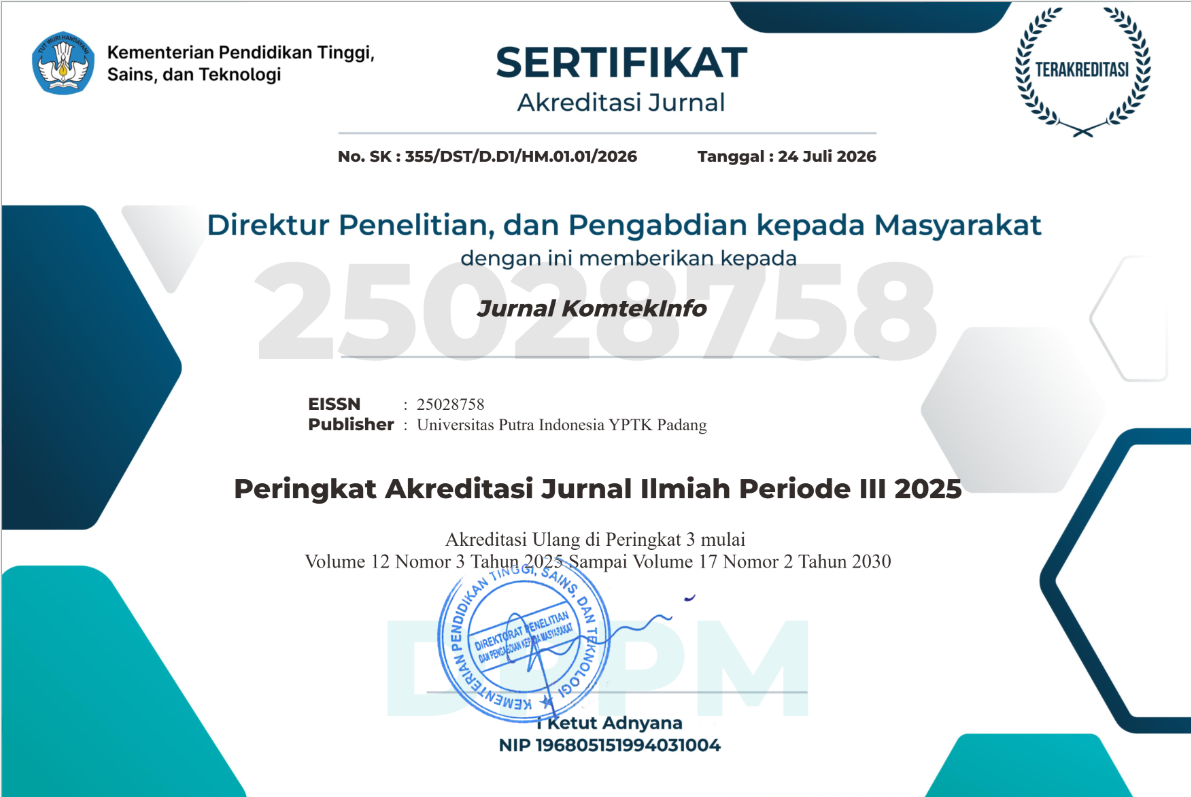
 KomtekInfo has launched a new template since Vol. 12, No. 2, (2025)