
Analysis of Strategies for Improving Learning Quality Based on Naive Bayes and Support Vector Machines
DOI:
https://doi.org/10.35134/komtekinfo.v13i2.682Keywords:
Learning quality, Islamic boarding school, Data mining, Naïve Bayes, Support Vector Machine (SVM)Abstract
Islamic educational institutions, particularly Islamic boarding schools, face increasing challenges in improving the quality of learning. The learning quality in Islamic boarding schools should be analyzed in depth to support effective improvement strategies. Based on this background, this study aims to classify strategies for enhancing learning quality using the Naïve Bayes and Support Vector Machine (SVM) algorithms. Naïve Bayes with a Gaussian distribution is widely recognized for its simplicity and accuracy in data classification. Meanwhile, Support Vector Machines (SVM) with a linear kernel are effective for linearly separable and high-dimensional data, enabling stable and efficient modeling in the context of data-driven analysis of learning quality in formal education. The data were collected through questionnaires distributed to 100 female students and 100 teachers. The variables examined include teacher competence, infrastructure, school management, student participation, and learning quality level. The analysis results indicate that the Naïve Bayes algorithm achieved superior performance with an accuracy of 90%, precision of 95.65%, recall of 83.33%, and an F1-score of 86.56%. In contrast, the Support Vector Machine (SVM) obtained an accuracy of 80%, precision of 58.97%, recall of 66.67%, and an F1-score of 62.32%.These findings demonstrate that Naïve Bayes provides more stable classification performance across all learning quality categories. Conversely, the Support Vector Machine (SVM) shows less optimal performance in the low-quality class due to the limited number of data samples. This study contributes effectively to the classification of learning quality levels in Islamic boarding schools
References
A. Amobonye, J. Lalung, G. Mheta, and S. Pillai, “Writing a Scientific Review Article: Comprehensive Insights for Beginners,” The Scientific World Journal, vol. 2024, pp. 1–13, Jan. 2024, doi: 10.1155/2024/7822269.
S. Nundy, A. Kakar, and Z. A. Bhutta, “How to Write the Introduction to a Scientific Paper?,” in How to Practice Academic Medicine and Publish from Developing Countries?, Singapore: Springer Nature Singapore, 2022, pp. 193–199. doi: 10.1007/978-981-16-5248-6_17.
C. Busse and E. August, “How to Write and Publish a Research Paper for a Peer-Reviewed Journal,” Journal of Cancer Education, vol. 36, no. 5, pp. 909–913, Oct. 2021, doi: 10.1007/s13187-020-01751-z.
S. Sobari et al., “Meningkatkan Model Prediksi Kelulusan Santri Tahfidz … Menggunakan Random Forest,” JITET, 2025.
D. N. Asy’ari et al., “Implementation of Digital Guided Discovery Learning at Ibrahimy Boarding School,” IEEE WAIE, 2024.
R. M. Sapdi et al., “Exploring Classification Algorithms for Detecting Learning Loss in Islamic Religious Education: A Comparative Study,” International Journal on Informatics Visualization, 2024.
L. F. Azevedo, F. Canário-Almeida, J. Almeida Fonseca, A. Costa-Pereira, J. C. Winck, and V. Hespanhol, “How to write a scientific paper—Writing the methods section,” Rev Port Pneumol, vol. 17, no. 5, pp. 232–238, Sep. 2011, doi: 10.1016/j.rppneu.2011.06.014.
S. K. Arora and D. Shah, “Writing methods: How to write what you did?,” Indian Pediatr, vol. 53, no. 4, pp. 335–340, Apr. 2016, doi: 10.1007/s13312-016-0847-7.
S. R. N. Reis and A. I. Reis, “How to write your first scientific paper,” in 2013 3rd Interdisciplinary Engineering Design Education Conference, IEEE, Mar. 2013, pp. 181–186. doi: 10.1109/IEDEC.2013.6526784.
Yuhefizar, R. Watrianthos, and R. Komalasari, “An LDA Analysis for Topic Modeling of the RESTI Journal,” in 2024 2nd International Symposium on Information Technology and Digital Innovation (ISITDI), IEEE, Jul. 2024, pp. 46–52. doi: 10.1109/ISITDI62380.2024.10796703.
Ronal Watrianthos and Y. Yuhefizar, “Exploring Research Trends and Impact: A Bibliometric Analysis of RESTI Journal from 2018 to 2022,” Jurnal RESTI (Rekayasa Sistem dan Teknologi Informasi), vol. 7, no. 4, pp. 970–981, Aug. 2023, doi: 10.29207/resti.v7i4.5101.
IEEE, “IEEE Editorial Style Manual for Authors,” IEEE Editorial, 2019.
O. Tur, A. Tur, V. Shabunina, and E. Chernaia, “The IEEE Style: Peculiarities of the Format and Application Prospects,” in 2020 IEEE Problems of Automated Electrodrive. Theory and Practice (PAEP), IEEE, Sep. 2020, pp. 1–4. doi: 10.1109/PAEP49887.2020.9240790.
D. J. S. Montagnes, E. I. Montagnes, and Z. Yang, “Finding your scientific story by writing backwards,” Mar Life Sci Technol, vol. 4, no. 1, pp. 1–9, Feb. 2022, doi: 10.1007/s42995-021-00120-z.
D. R. Hess, “How to Write an Effective Discussion,” Respir Care, vol. 68, no. 12, pp. 1771–1774, Dec. 2023, doi: 10.4187/respcare.11435
A. Ramadhanu, H. Hendri, F. Hadi, D. Guswandi, D. M. Putra, R. Hardianto, and S. D. Rizki, “Hybrid decision support system and image processing for classifying priority applications in the Padang Government,” CSRID (Computer Science Research and Its Development Journal), vol. 18, no. 1, pp. 178–191, 2026.
A. Ramadhanu, H. Hendri, and F. Hadi, “Organic fertilizer content detection based on image segmentation and texture analysis,” in Proc. 2025 International Conference on Informatics, Multimedia, Cyber and Information System (ICIMCIS), Dec. 2025, pp. 50–55.
Downloads
Published
How to Cite
Issue
Section
License
Copyright (c) 2026 Jurnal KomtekInfo

This work is licensed under a Creative Commons Attribution 4.0 International License.

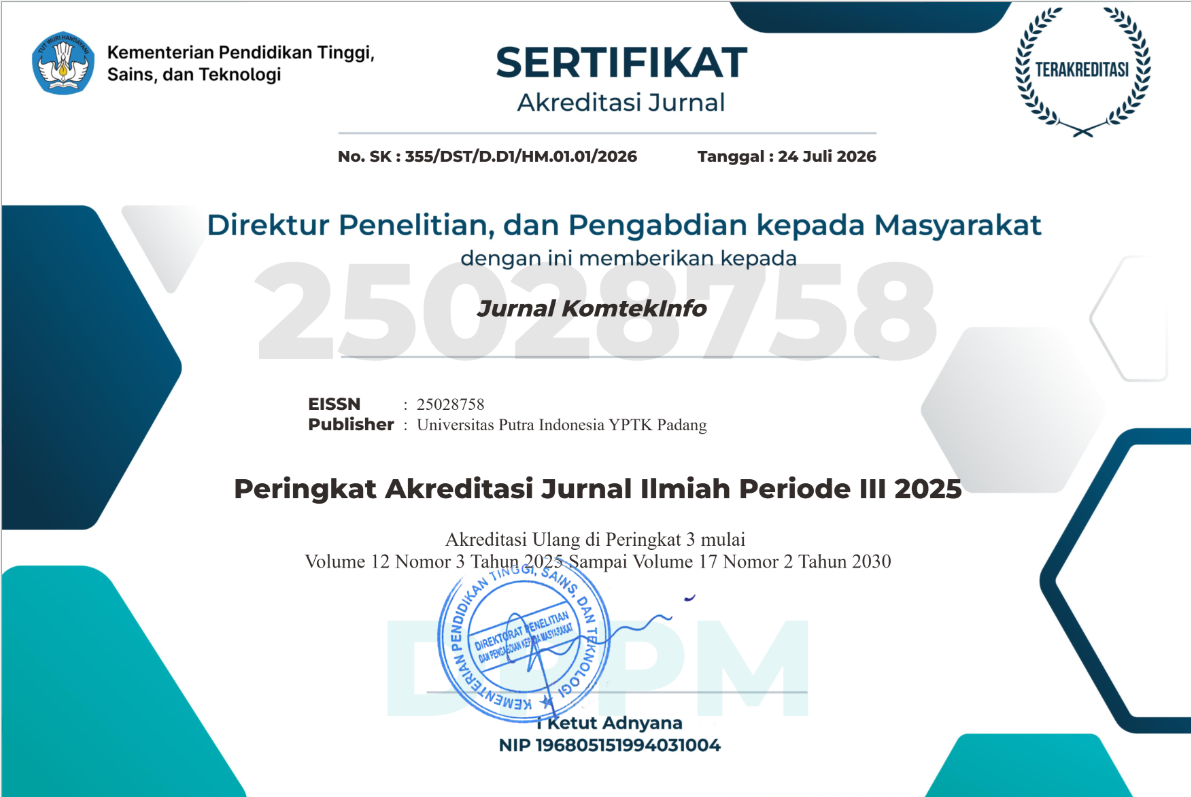
 KomtekInfo has launched a new template since Vol. 12, No. 2, (2025)