
Integrating Educational Data Mining through Decision Tree and Random Forest Comparison for Assessing Employment Suitability
DOI:
https://doi.org/10.35134/komtekinfo.v13i3.703Keywords:
DT, RF, Alumni Employment SuitabilityAbstract
Educational Data Mining can be utilized to identify patterns in educational data and support the evaluation of the alignment between graduates’ competencies and labor market requirements. Assessing alumni employment suitability is essential for providing an overview of their readiness and job alignment after completing their education. This study aims to compare the performance of the Decision Tree (DT) and Random Forest (RF) algorithms in classifying alumni employment suitability levels. The research stages included data collection, selection of employed alumni data, data cleaning, transformation of categorical variables into numerical scores, target label construction, division of the dataset into training and testing sets, and class balancing using Random Over-Sampling. The classification models were constructed using the DT and RF algorithms and evaluated based on accuracy, precision, recall, F1-score, and confusion matrix. The dataset was obtained from the 2025 Alumni Tracer Study conducted by Universitas Negeri Padang and comprised 2,831 records with eleven variables related to alumni employment and competencies. The results indicate that the Decision Tree achieved an accuracy of 83.42%, a macro-averaged precision of 76.74%, a macro-averaged recall of 76.82%, and a macro-averaged F1-score of 76.59%. Random Forest demonstrated better performance, achieving an accuracy of 90.83%, a macro-averaged precision of 83.85%, a macro-averaged recall of 82.22%, and a macro-averaged F1-score of 82.94%. This study contributes an Educational Data Mining-based approach that can assist higher education institutions in evaluating alumni employment suitability and provide a basis for formulating policies aimed at improving graduates’ competencies.
References
R. Haque, A. Quek, C.-Y. Ting, H.-N. Goh, and R. Hasan, “Classification Techniques Using Machine Learning for Graduate Student Employability Predictions,” vol. 14, no. 1, 2024.
S. Y. Ong, C. Y. Ting, H. N. Goh, A. Quek, and C. L. Cham, “Workplace Preference Analytics Among Graduates,” Journal of Informatics and Web Engineering, vol. 2, no. 2, pp. 233–248, Sep. 2023, doi: 10.33093/jiwe.2023.2.2.17.
H. N. Mpia, L. W. Mburu, and S. N. Mwendia, “Applying Data Mining in Graduates’ Employability: A Systematic Literature Review,” 2023, International Association of Online Engineering. doi: 10.3991/IJEP.V13I2.33643.
C. Munthali et al., “A graduate tracer study of the diploma in nursing program at Saint John of God College of Health Sciences in Mzuzu, Malawi: A descriptive survey design,” Int. J. Afr. Nurs. Sci., vol. 23, p. 100925, Jan. 2025, doi: 10.1016/J.IJANS.2025.100925.
S. Anastassia, A. Kharis, A. Haqqi, and A. Zili, “TANTANGAN DAN PELUANG EDUCATIONAL DATA MINING DAN LEARNING ANALYTICS PADA PENDIDIKAN JARAK JAUH DI INDONESIA,” Prosiding Seminar Nasional Sains dan Teknologi “SainTek,” vol. 1, no. 2, pp. 218–225, Aug. 2024, Accessed: Apr. 15, 2026. [Online]. Available: https://conference.ut.ac.id/index.php/saintek/article/view/2536
E. Kalita et al., “Educational data mining: a 10-year review,” Discover Computing 2025 28:1, vol. 28, no. 1, pp. 81-, May 2025, doi: 10.1007/S10791-025-09589-Z.
S. Hidayatuloh and D. Wangsa Samudera, “PERBANDINGAN AKURASI METODE NAÏVE BAYES, DECISION TREE (C.45), DAN RANDOM FOREST DALAM MELAKUKAN PREDIKSI MASA TUNGGU KERJA ALUMNI BERDASARKAN DATA TRACER STUDY PADA FAKULTAS PSIKOLOGI UIN JAKARTA”, doi: 10.37817/Tekinfo.v26i1.
N. Sulistiyaningsih and R. Rismayati, “Comparison of Random Forest, Decision Tree, and XGBoost Models in Predicting Student Academic Success,” Journal of Artificial Intelligence and Software Engineering, vol. 5, no. 3, pp. 920–930, 2025, doi: 10.30811/jaise.v5i3.7138.
L. G. Hamilton, “Emotionally Based School Avoidance in the Aftermath of the COVID-19 Pandemic: Neurodiversity, Agency and Belonging in School,” Education Sciences 2024, Vol. 14, Page 156, vol. 14, no. 2, p. 156, Feb. 2024, doi: 10.3390/EDUCSCI14020156.
N. Wati and S. Mamase, “DECISION TREE,” JTII, vol. 07, no. 02, 2022.
Chen Sa and Lin Xiankun, “Application of Decision Tree Algorithm in Educational Data Mining,” Curriculum and Teaching Methodology, vol. 6, no. 8, 2023, doi: 10.23977/curtm.2023.060818.
H. Blockeel, L. Devos, B. Frénay, G. Nanfack, and S. Nijssen, “Decision trees: from efficient prediction to responsible AI,” 2023, Frontiers Media SA. doi: 10.3389/frai.2023.1124553.
P. Ayu Firnanda et al., “Analisis Perbandingan Decision Tree dan Random Forest dalam Klasifikasi Penjualan Produk pada Supermarket,” Emerging Statistics and Data Science Journal, vol. 3, no. 1, pp. 445–461, Jan. 2025, doi: 10.20885/ESDS.VOL3.ISS.1.ART2.
D. K. Dake, “Information technology graduates employability prediction model in a low-income country using tree-based machine learning classifiers,” Discover Global Society, vol. 3, no. 1, Dec. 2025, doi: 10.1007/s44282-025-00304-3.
Y. Li and Y. Mu, “Research and performance analysis of random forest-based feature selection algorithm in sports effectiveness evaluation,” Sci. Rep., vol. 14, no. 1, Dec. 2024, doi: 10.1038/s41598-024-76706-1.
R. Shankar and A. Yip, “Transforming Patient Feedback Into Actionable Insights Through Natural Language Processing: Knowledge Discovery and Action Research Study.,” JMIR Form. Res., vol. 9, no. 1, p. e69699, Aug. 2025, doi: 10.2196/69699.
E. Rohaeti and A. Andriyati, “Comparative Study of Predictive Classification Models on Data with Severely Imbalanced Predictors,” 2024.
J. Chaidir and J. Friadi, “ZONA TEKNIK: JURNAL ILMIAH Evaluasi Kinerja Algoritma Klasifikasi dalam Studi Kasus Prediksi Kelulusan di Universitas XYZ,” vol. 19, no. 1, pp. 15–22, 2025, doi: 10.37776/zt.vxix.xxx.
A. Prof, D. Davuth, and M. Dy Davidseihakbot, “Topic: A Machine Learning Approach to Identifying Factors Influencing Alumni Career Success in Tracer Study: A Case Build Bright University.”
R. Bagus Prakoso, D. Lutfianawati, U. Malahayati, and B. Lampung, “Hubungan Antara Efikasi Diri Dan Kesadaran Metakognitif Dengan Kesiapan Kerja Mahasiswa Tingkat Akhir,” Nathiqiyyah, vol. 8, no. 2, pp. 201–216, Dec. 2025, doi: 10.46781/NATHIQIYYAH.V8I2.1762.
M. Guo et al., “Normal Workflow and Key Strategies for Data Cleaning Toward Real-World Data: Viewpoint.,” Interact. J. Med. Res., vol. 12, no. 1, p. e44310, Sep. 2023, doi: 10.2196/44310.
R. Mao, X. Shi, Z. Shi, R. Mao, X. Shi, and Z. Shi, “A Decision Tree Classification Algorithm Based on Two-Term RS-Entropy,” Entropy 2025, Vol. 27, vol. 27, no. 10, Oct. 2025, doi: 10.3390/E27101069.
Downloads
Published
How to Cite
Issue
Section
License
Copyright (c) 2026 Jurnal KomtekInfo

This work is licensed under a Creative Commons Attribution 4.0 International License.
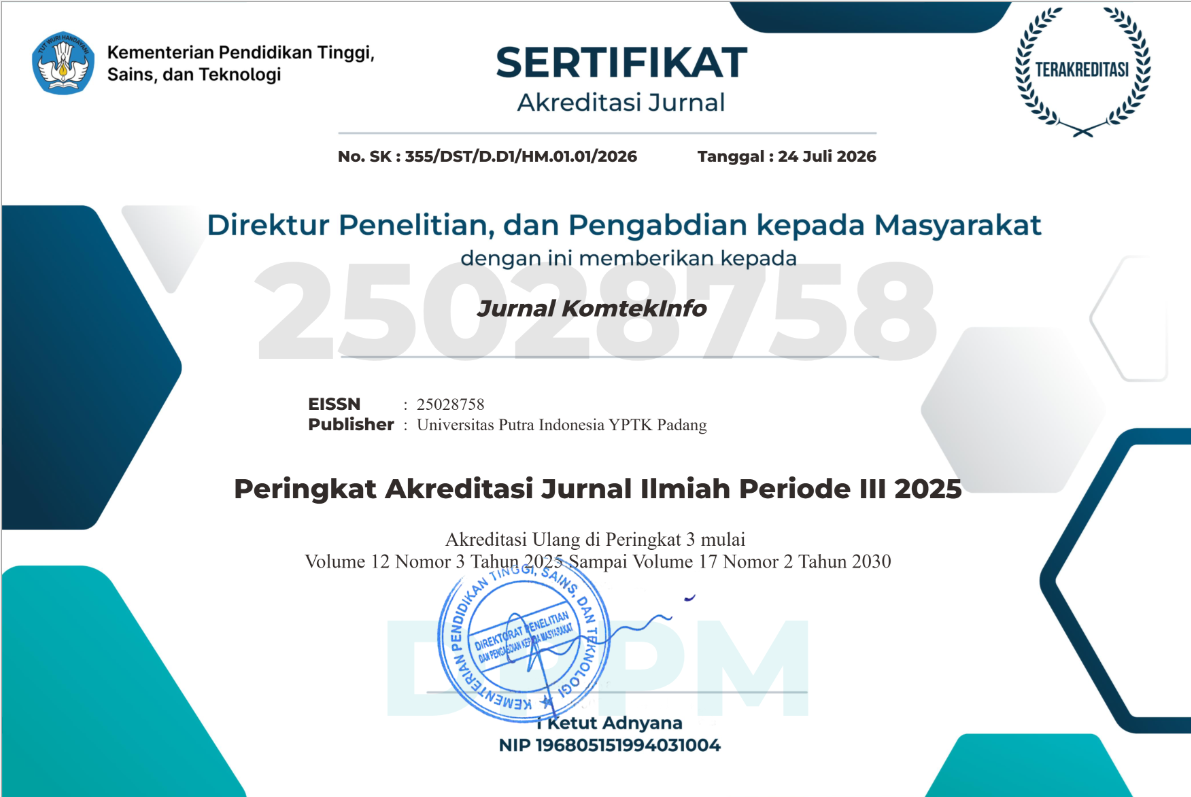
 KomtekInfo has launched a new template since Vol. 12, No. 2, (2025)