
Clustering of Bandwidth Usage Patterns of Regional Government Organizations in Solok City Using a Combination of Self-Organizing Map and K-Means
DOI:
https://doi.org/10.35134/komtekinfo.v13i3.705Keywords:
bandwidth, SOM, K-Means, OPD, Kota SolokAbstract
Differences in the intensity of digital services across Regional Government Organizations (OPDs) within the Solok City Government result in varying bandwidth requirements among institutions. Uniform capacity allocation does not adequately reflect these differences and may lead to network inefficiencies. This study classified bandwidth-usage patterns using a combination of the Self-Organizing Map (SOM) and K-Means Clustering to provide a basis for more proportional bandwidth allocation. The dataset comprised 1,326 daily records from 26 OPDs collected between March and May 2026, including upload volume, download volume, number of employees, and number of active applications. Data processing involved outlier detection, aggregation, Min-Max normalization, SOM training on a 5 × 5 grid, determination of the optimal number of clusters using the Elbow Method, selection of initial centroids from the extreme points of the SOM map, and final clustering using K-Means. The SOM mapping produced a Quantization Error of 0.040207 and a Topological Error of 0.076923. Three clusters were identified as the optimal configuration. The SOM–K-Means model achieved a Silhouette Score of 0.448335, a Davies–Bouldin Index of 0.817415, and a WCSS value of 2.702929, outperforming conventional K-Means. The final results classified 11 OPDs into the high-usage category, 4 into the moderate-usage category, and 11 into the low-usage category. These findings provide an empirical basis for allocating bandwidth according to the usage characteristics of each OPD
References
M. S. J. Sangaji and J. Irianto, “Transformasi Inovasi Pelayanan Publik menuju Pemerintahan Digital,” Jejaring Administrasi Publik, vol. 17, no. 1, pp. 54–70, Jun. 2025, doi: 10.20473/jap.v17i1.72708.
D. Mutiarin, Misran, N. S. Rukmana, and T. Ningtyas, “Bridging the digital divide through digital infrastructure,” Journal of Infrastructure, Policy and Development, vol. 8, no. 8, 2024, doi: 10.24294/jipd.v8i8.6817.
A. Haastrup, M. Zehri, D. Rincón, J. R. Piney, and A. Bazzi, “A Distance-Weighted Dynamic Bandwidth Allocation Algorithm for Improved Performance in Long-Reach Passive Optical Networks for Next Generation Networks,” Photonics, vol. 10, no. 8, Aug. 2023, doi: 10.3390/photonics10080923.
D. M. Amitu, R. N. Akol, and J. Serugunda, “Dynamic priority-based bandwidth allocation scheme for machine type communications,” EURASIP J. Wirel. Commun. Netw., vol. 2024, no. 1, Dec. 2024, doi: 10.1186/s13638-024-02400-5.
R. Mubarak, S. Defit, and G. W. Nurcahyo, “Algoritma K-Means Clustering Penggunaan Bandwidth Internet (Studi Kasus di Pemerintah Daerah Kabupaten Padang Pariaman),” Explore: Jurnal Sistem Informasi dan Telematika, vol. 14, no. 1, p. 37, Jul. 2023, doi: 10.36448/jsit.v14i1.3037.
A. Guérin, P. Chauvet, and F. Saubion, “A Survey on Recent Advances in Self-Organizing Maps,” Dec. 2024, [Online]. Available: http://arxiv.org/abs/2501.08416
S. Licen, A. Astel, and S. Tsakovski, “Self-organizing map algorithm for assessing spatial and temporal patterns of pollutants in environmental compartments: A review,” Jun. 20, 2023, Elsevier B.V. doi: 10.1016/j.scitotenv.2023.163084.
S. Rezvani and E. A. Jorswieck, “Optimal Water-Filling Algorithm in Downlink Multi-Cluster NOMA Systems,” Jun. 2021, [Online]. Available: http://arxiv.org/abs/2106.08636
Y. Miftahuddin and A. R. S. Ridwan, “Application of Self-Organizing Map and K-Means to Cluster Bandwidth Usage Patterns in Campus Environment,” Jurnal Online Informatika, vol. 10, no. 1, pp. 66–76, Apr. 2025, doi: 10.15575/join.v10i1.1438.
M. Walid, N. L. N. Sahbaniya, H. Hozairi, F. Baskoro, and A. Y. Wijaya, “K-Means Clustering and Multilayer Perceptron for Categorizing Student Business Groups,” Knowledge Engineering and Data Science, vol. 6, no. 1, p. 69, Jul. 2023, doi: 10.17977/um018v6i12023p69-78.
Mei Yanda Maharani Messakh, Jusuf Ezra Rudolf Fransz, David Hermanus, Adriana Fanggidae, and Yulianto Triwahyuadi Polly, “Clustering Dataset Numerik Multivariat menggunakan Algoritma K-Means dengan Evaluasi Silhouette dan Davies–Bouldin Index,” Jurnal Teknik Informatika dan Teknologi Informasi, vol. 6, no. 1, pp. 356–368, May 2026, doi: 10.55606/jutiti.v6i1.6748.
N. Aminudin, N. Hidayat, D. Feriyanto, D. Septasari, and I. Awaliyani, “Digital Landscape and Behavior in Indonesia 2024: A National Survey Analysis of Internet Penetration, Cybersecurity Risks, and User Segmentation Using K-Means Clustering and Logistic Regression,” Jurnal Teknik Informatika (Jutif), vol. 6, no. 5, pp. 3336–3351, Oct. 2025, doi: 10.52436/1.jutif.2025.6.5.5117.
Y. Seo, D. Lim, J. Lee, J. So, and H. Kim, “A Framework for Evaluating Driving Patterns of Automated Vehicle Based on On-Road Driving Records,” IEEE Access, vol. 13, pp. 67894–67907, 2025, doi: 10.1109/ACCESS.2025.3556299.
I. Panitsas and L. Tassiulas, “A Family of Open Time-Series Foundation Models for the Radio Access Network,” Apr. 2026, [Online]. Available: http://arxiv.org/abs/2604.04271
N. Suarna and Y. Arie Wijaya, “ANALISA PENERAPAN METODE CLUSTERING K-MEANS UNTUK PENGELOMPOKAN DATA TRANSAKSI KONSUMEN (Studi Kasus: Cv. Mitra Indexindo Pratama),” 2023.
A. Brijith, “Data Preprocessing for Machine Learning.”
M. Ariesta, I. Setiawan, P. Sistem, T. Informasi, I. Teknologi, and D. B. Semarang, “SISTEM PENGENALAN RETINA MENGGUNAKAN SELF ORGANIZING MAP UNTUK MENDETEKSI RETINOPATI DIABETIKA,” 2023.
J. Homepage and S. Aziz, “IJIRSE: Indonesian Journal of Informatic Research and Software Engineering Implementation of Self Organizing Map Algorithm to Identify the Grouping Patterns of Family Welfare Level in Siak Regency Implementasi Algoritma Self Organizing Map untuk Identifikasi Pola Pengelompokan Tingkat Kesejahteraan Keluarga Kabupaten Siak,” vol. 2, no. 2, 2022.
A. E. Widjaja, A. Fransisko, C. A. Haryani, and Hery, “Text Mining Application with K-Means Clustering to Identify Sentiments and Popular Topics: a Case Study of the three Largest Online Marketplaces in Indonesia,” Journal of Applied Data Sciences, vol. 4, no. 4, pp. 441–453, Dec. 2023, doi: 10.47738/jads.v4i4.134.
Downloads
Published
How to Cite
Issue
Section
License
Copyright (c) 2026 Jurnal KomtekInfo

This work is licensed under a Creative Commons Attribution 4.0 International License.
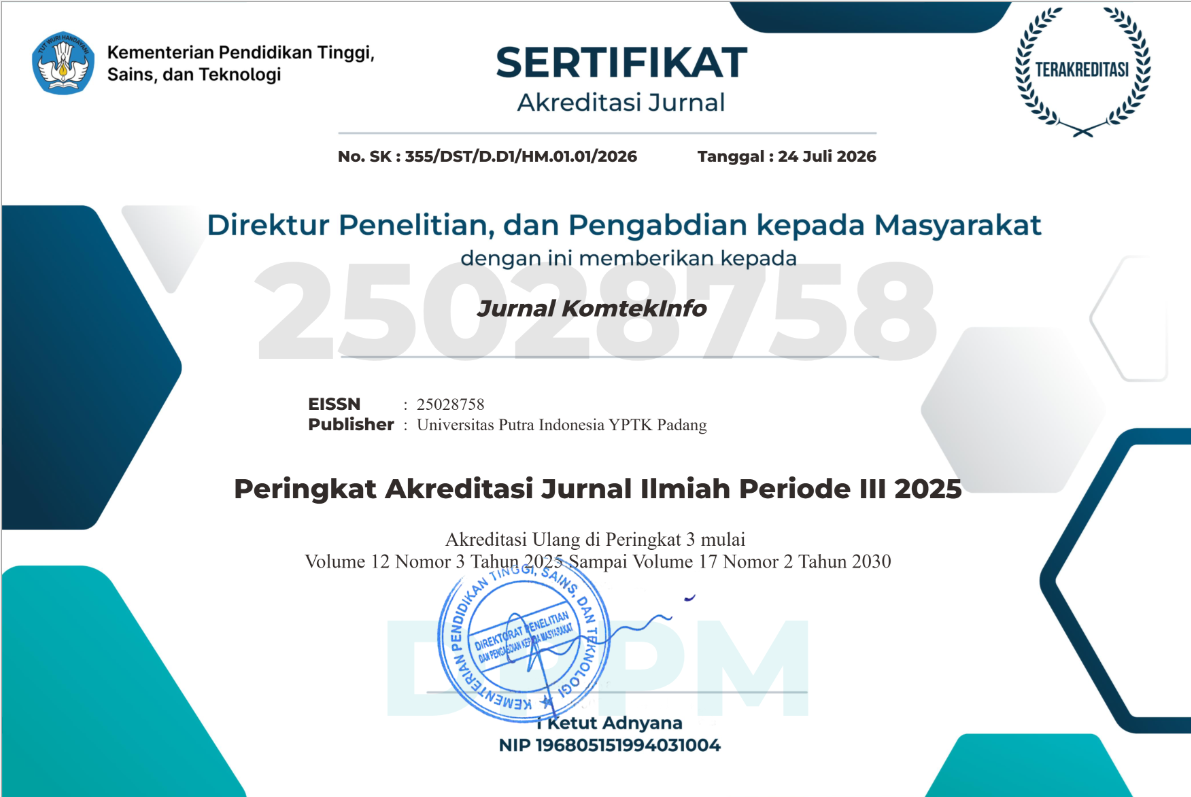
 KomtekInfo has launched a new template since Vol. 12, No. 2, (2025)